Thursday, February 6, 2014

News, Ulaanbaatar East Zone Conference.


Zone conference led by Pres. Benson
Teaching English. We found out that the University we were to teach at is undergoing some organizational changes. It is too complicated to bring us in as English teachers.
Our sponsor is lining us up to do some tutoring with someone from the Ministry of Foreign Affairs. It remains to be seen if this will materialize or not.
We were delighted to have the extra time to get a lot of personal things accomplished prior to the end of our mission. As much as we've enjoyed teaching English and our students, it is a relief not to have pressure and preparation time – especially at this point in our mission. I’ve had more time to keep up to devote to our blog – like this one.
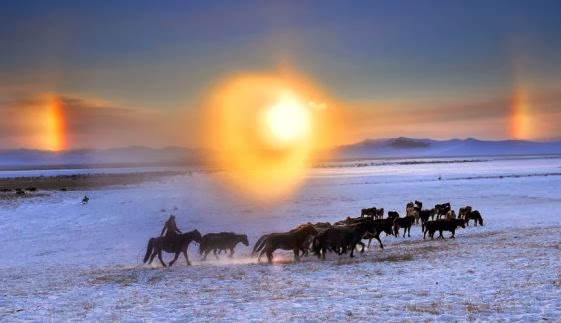
Sun dogs in Inner Mongolia - from the China News Service
The Woods go home from their mission on Feb. 27. We have been asked to consider teaching their evening English class at the church during March. One month we can manage.

Our last hurrah outside of UB. We will spend four days in Choibalsan at the end Feb and the beginning of March. Our country advisor, Puujee will travel with us and assist in the Family History training. She will leave on a Sunday afternoon and we will leave Monday.

Pres. Benson asked us to do some special training on Home Teaching and Visiting Teaching while we are there. He is involving all the senior couples as visitors to the Mission Branches to boost the frequency of training and the quality of leadership in those units.

We will travel to Baganuur (125 km east of UB) on Feb. 16 to attend the Woods' last meeting there (it has been their assigned branch for the duration of their mission).
The Woods have served as the office couple
Batbayar and his wife are recent converts. We had some special experiences with him helping put his family history on Family Tree. He has invited us to his home after church that Sunday.
 A new grandson. Our daughter Tawny Farmer Kesner (who served as a missionary in Mongolia 1998 – 2000) had her fifth child on Jan. 26. 


His name is Max Benjamin Kesner. He is our 27th grandchild. We met him on Skype and will meet him in person quicker than we think.  All is well with mother and child.
Lead photo from the Atlantic magazine article

Facebook of Mormon. This month's Atlantic magazine had major article on how the church's missionary program is using social media to spread the gospel.

It is ironic that the main picture introducing the article was of two Elders in a Ger District in Mongolia even though missionaries in this mission haven't yet been authorized to use social media,
East Zone - Feb. 5, 2014
East Zone Conference.  Even though this is not our zone, the Assistants to the President invited me to take some photographs during the day. I didn’t mind a bit.
Elder Munkhchudur teaching about conflict resolution

I spent some time training the Assistants on how to teach communication and conflict resolution skills. I enjoyed seeing how they implemented the training.  They did a great job!
Elders Ocorjamaa and Munkhchudur role played a companionship with poor conflict resolution skills. It was hilarious.
Pres. Benson was really pleased with the result and will keep the training for future use. Here are some pictures I took during the day.
President Benson is a 'hands on" leader and trainer.
The Zone leaders and Sister Trainers also were actively training
                           Lunch is good!
Senior couples attended the zone conference and had translation services all day

Photos for missionaries and their parents. I also took some individual and small group pictures which I either email to parents of the missionaries or print copies to give to the missionaries personally.


These are three of my favorites.


Three Elders communicating in sign language. The Elder in the middle recently received a cochlear implant operation. It was arranged Dr. Stewart. He procured a donation of $72,000 to pay for the surgery, hospitalization, and implants from a group "Kindness in Action" in Canada." Of the six recipients, five were church members, our Elder being one of them.
Missionaries have difficulty sending photos home because of time constraints and slow internet service at the Internet Cafes. Also as seniors, we have more opportunity to take pictures than the missionaries whose schedule is more demanding  and focused on teaching the gospel.

It is a little extra service I can provide that brings the mission alive for loved ones who want to visualize better what their son or daughter is experiencing in Mongolia.  Elder Stewart (the mission doctor) is another senior missionary who takes pictures of members and missionaries and gives them out freely.  

 
The missionaries have just read the Book of Mormon in 90 days and are starting a new 90 day program. They have a study plan they follow. They study Preach My Gospel and learn a language (either English or Mongolian) while serving on their mission. 

Wednesday, February 5, 2014

Tsaagan Sar holiday and visits


Odgerel's grandmother invites all the senior couples to her home every Tsaagan Sar

Part of the month preceding Tsaagan Sar or Lunar New Year is spent cleaning the home, buying gifts and getting food, meat and buuz purchased, prepared, and ready to serve to visitors. 
Guest table at Altansukh's home
The night before the lunar New Year is Bituun. The immediate family gathers and has a feasting meal together.
Buyandelger and her daughter Enkhtuya in front of their table
There are three official holidays set aside for these visits and a day of rest afterward. In the countryside, the visits extend a week. Mongolian families start off visiting immediate family first and then spread out to visit close friends and then more distant relatives the second or third day of Tsaagan Sar.
The man at the right is a high ranking government official who came to pay tribute to his former teacher
Children living far from home have a month to visit parents or grandparents during Tsaagan Sar. If no visit is made, there is liable to be hurt feelings. 
Buyandelger's daughter came from Sweden for her first visit home in three years. Darlene's piano student and Buyandelger's granddaughter, Buyanzaya, is on the right
Adult children living in other countries try to come home every three years or so for Tsaagan Sar.
Altansukh's family with the Farmers 
 
A typical Tsaagan Sar visit.  Appointments are 

arranged in advance so your visit doesn’t overlap

with other guests. Plan on a two 2 – 2 ½ hour

visit. 

Buted's family with all the guests. Pres. Benson, Sister Benson and Isabel are standing on the left while the other three children are on the front row. Mary Ann is on the opera student's lap.
If new guests arrive during your visit, you hurry  your visit so the new guests have undivided attention and can do their traditional greetings with the host or hostess. 

Sometimes the new arrivals are introduced to the guests already present and Tsaagan Sar greetings are exchanged between of old and arriving guests. Sometimes the arriving guests stay discreetly out of the way until the previous guests have left.

One of our Hong Kong temple trip patrons, Ariuna, on right with her daughter, Oyun-Erdene, on left
Once a host family has entertained their keys guests, they join the parade of visitors and make visits to other homes and family members. Elderly members of the family have the visitors come to them and are not expected to visit other homes.

The greeting. You are greeted warmly. You take off your shoes at the door and are offered slippers or shoe coverings. You remove your coat but leave your hat, scarf or head gear on until after the formal greetings have been made.
You seek out the oldest family member present (male and then female). You put your outstretched hands under theirs and greet them with either a light kiss on each side of the face or brush your cheeks against theirs. The symbolism is that guests or family members pledge their support by putting their arms under the older person's arms.

For a traditional greeting, Mongolians guests and family members carry a khadag – a ceremonial blue cloth - in their outstrechted arms - as they greet each the host.  
You ask each other, "Is your life peaceful?"
If the host or hostess in the 60s, 70s or 80s, you give him or her a gift of money after the greeting. It depends on the closeness of the relationship but a typical gift is in the range of $14 down to about $ 3.   

If you are appreciably older than the host, they seat you at a place of honor and come to greet you in a similar fashion. No money is given to the guest.
Exquisite sense of beauty and presentation
The table.  At the head of the table is a stack of layered breads showing how many decades of life the host has lived. Each decade represents an alternating decade of happiness or adversity. 

White candies and other white nibble food are interspersed among the layers of bread.  
Shuraai goes all out for her many guests. The Nays on the right and the Farmers were quite the sight in their blue deels
For an elaborate meal, a cut up, cooked sheep is also on the table with the highly prized rump section and the head sitting on top.

The food. You are seated at a table and are offered a lightly salted hot milk drink (kharum) or fermented mare’s milk (aireg) which you sip. You eat something "white" first, rice, a white candy or a piece of dried white cheese or yogurt. 
 
The salads and side dishes are so tasty that you fill up before the buuz are served
Then you are served a variety of salads and side dishes – all tasty and exquisitely prepared and beautifully presented. 

There is also an additional traditional greeting ritual of passing a snuff bottle to the guests where they ceremonially receive it, sniff it approvingly and hand it back to the host or pass it along to the next guest at the table. This may not be the case in most visits, but in highly ritualized greetings it is done.

As the meal progresses, cold cuts from the sheep are served to the guests. They are surprisingly tasty and delicious, considering Americans lack of familiarity with lamb or mutton.

Gradually hotter and hotter side dishes are put on the table culminated by generous serving of buuz, a specially prepared plate of steamed meat dumplings. You pick up a dumpling with your fingers, bite off a corner and slurped on the juice out of it before eating the dumpling either in one bite or in a few smaller bites. 

Guests are encouraged to eat at least five buuz and are encouraged to eat more and more until the guest definitely says no. No visit is complete until the buuz is served and eaten.

After our meal our hostess, Buted, a famous opera singer in Mongolia, sang for us
Conversation. All this time you engage in pleasant conversation with the family members present. Photo albums are often brought out and shown  during these visits. In some homes, not church families, vodka is offered and toasts are made as the meal draws to a close. 

As you leave the host presents each visitor with a gift – not cheap – in the $5 - $10 range. It is considered ungracious not to accept a host or hostess gift.

Buted invited one of her voice students to perform for us
Repeat…and repeat. It takes time to travel to your next appointment and keep on schedule. The next visit follows the same pattern as the first visit. 

Many foreigners who have three of four visits in a day complain about how stuffed they are but still are expected to have an appetite at the next home. And the next day....and the next day. Even Mongolians find this hard – way too much food – way too many buuz. 

It is like going to two or three thanksgiving dinners on the same day with exquisite plentiful food and watchful eyes on you at each visit. The minute your plate or bowl is empty, the host of hostess is quick to replenish the food on your plate or on the table.
Our favorite tour guide, Jangar, and his family
Each visit leaves a warm glow of friendship and love. It is at once an ordeal and a beautiful, healthy family tradition – both from the guests and hosts point of view.

Tuesday, February 4, 2014

Mongolian haircutting ceremony


A Mongolian haircutting ceremony. Mongolian children get their first haircut in early ages between 2-5. It is called Daah Urgeeh. Depending on the lunar calendar, boys receive their first hair cut on an even year and girls in an odd year.
The ceremony symbolizes the end of "babyhood" and the transition to "childhood".  The transition from babyhood was and is so important in Mongolian traditional culture. Surviving babyhood, especially for children of herding families with little access to medical facilities, was an occasion to celebrate.

The time and date for the haircutting are determined by the year in the lunar calendar when the child was born. Traditionally Buddhist lamas or monks would advise families on the best days and best years to do the ceremony.
Guests arrive during the day to participate. Offering food and drink to guests are a part of the celebration. Closest family members and friends are present at the beginning of the ceremony. We were the first guests so we saw the initiation of the ceremony.  Other families hold the haircutting ceremony with a formal banquet with all the guests present from the start.

A bald head. The child’s head becomes more and more unsightly as swatches of hair are randomly cut. At  the end of the day, after all the invited guests have finished, the child’s head is shaved - boys and girls alike - and the new hair grows out in a healthy fashion much like the symbolism of permanent teeth replacing baby teeth.
The khadag, a silky blue ceremonial cloth used in Tsaagan Sar greetings, with the hair knotted at one end is kept by the family and presented to the child at another stage (late pre-teen or early teen-age) in his or her life.
When you see Mongolian toddlers and children, it is difficult to tell the gender of the child because of their long hair. Then after the haircutting ceremony, it becomes equally difficult to tell the gender because of their shaved heads.

We quickly learned to pay attention to clothes before putting our feet in our mouths.
Our invitation. We were invited to a haircutting ceremony. This is an honor and a privilege as most foreigners don’t get to participate in this unique Mongolian coming of age ritual. We have been in Mongolia almost 20 months and this was our first invitation.

Our good friends from the Sukhbaatar Branch, Odgerel and Saranchimeg, invited us to come to their home at 8:00 am.
The eensy, weensy spider crawled up the water spout
We had previously bonded with Gerelsaran and she seemed to enjoy her relationship with us funny looking Caucasion old folks.
We are dressed in our deels because the haircutting ceremony took place during the Tsaagan Sar holidays.  
The first cut
How it is done. An older neighbor lady who knew the ritual thoroughly was there to guide the family through this process. The first cutting was done by a young cousin whose lunar birth year was an ideal match for the Gerelsaran's lunar birth year. I believe the person doing the second cutting was also determined by the same process.
Odgerel and his mother help Gerelsaran cooperate
The neighbor lady cut second. After that, different family members present took turns in no apparent order.
A cousin came down from Darkhan to participate
 A knot was tied in one end of a blue khadag as a depository for the locks of hair cut from the Gerelsaran’s head. The scissors were tied to the other end of the khadag. The person giving the haircut would be offered a drink of milk tea  (haarum) or, in some cases, fermented mare’s milk (aireg).
The guest or family member then offered the drink to the Gerelsaran.
Then a dab of milk is rubbed into Gerelsaran’s hair. A lock of hair is then cut and placed in the khadag.
Saranchimeg cuts while Odgerel will take the lock of hair

The guest or family member then offers the child a gift, usually money (symbol of good fortune) but it could be a toy and then gives a wish or a blessing. It is something simple like "Be a good person".
Gerelsaran is slipping money into her purse
In our situation, Gerelsaran quickly figured out she could put the money in her purse and this was a good deal. Once she made this connection, she cooperated with the unusual expectations of drinking ceremonial milk, having milk rubbed in her hair and allowing her hair to be cut.
It gets to be a long but profitable day


Friday, January 31, 2014

Enjoying the Tsaagan Sar Sunrise, West Zone Conference


Only in Mongolia. Last year at this time, Elders Stewart and England and a group of missionaries climbed a mountain on Tsaagan Sar morning. Both Darlene and I were recovering from the pneumonia that plagued us during most of January so I didn’t go on this particular outing.
New housing development at the base of the mountain we climbed
Elder Stewart brought back some amazing pictures of the Tsaagan Sar sunrise ritual. I made a note that I wanted to experience this year’s Tsaagan Sar in the same way.   
Elder Stewart was out of the city on assignment and the other seniors either had other commitments, didn’t want to go or were sick (Elder England). Elder Odd and I collaborated on a plan for climbing a mountain.
He approached Pres. Benson for permission. He said it would be OK if the group was small and that we should show respect for the culture and customs while witnessing the event.

Elders Moore, Hayter, Standley, Erickson, Higgs, and Odd
Six Elders and I (four were dressed in deels) climbed the mountain. We met at 7:00 am, took a couple of taxis to the base of the mountain (no buses were running that early on the holiday), and climbed to the top arriving at 8:05 am. Sunrise was as 8:22 am.


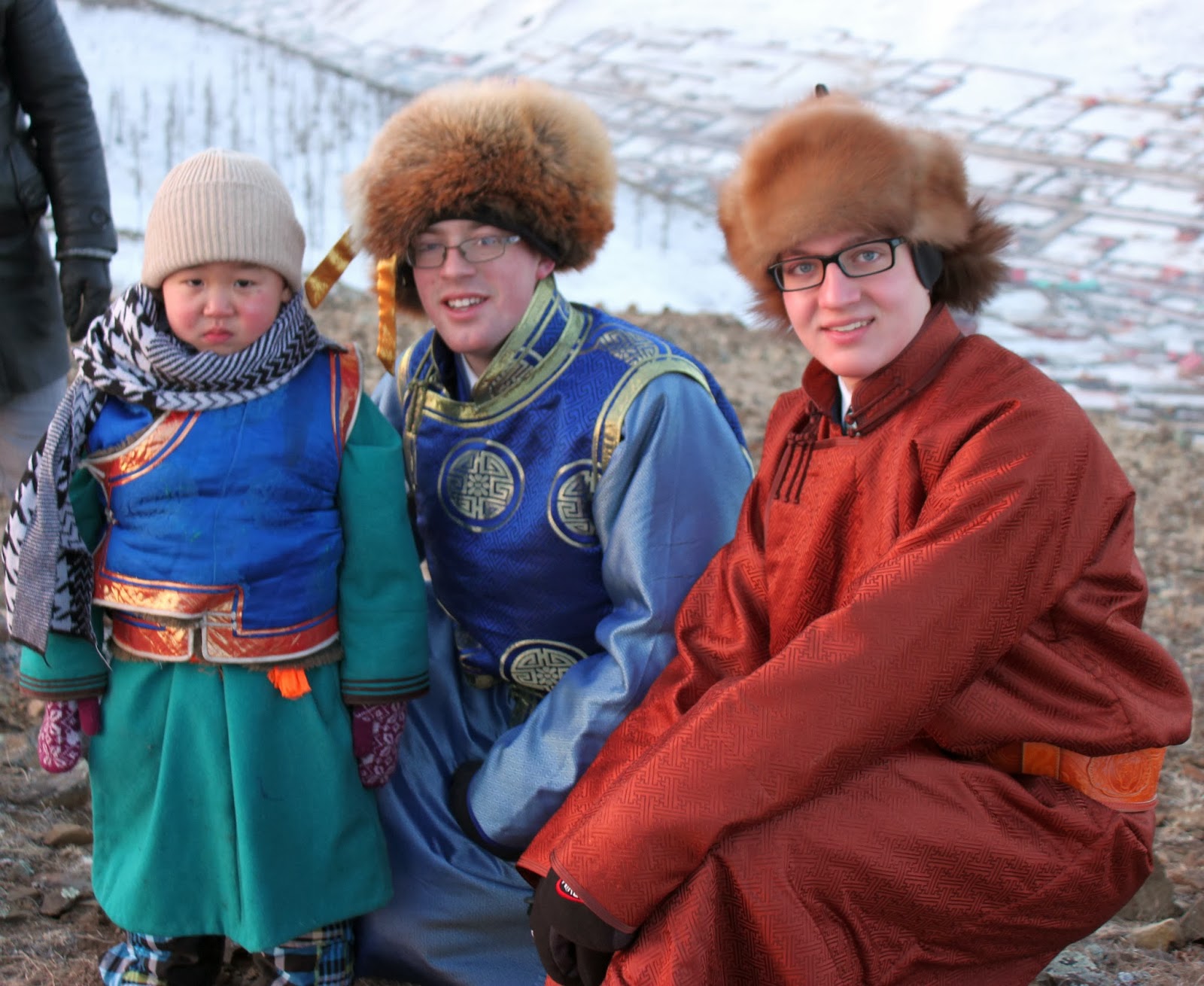
Elders Odd and Moore posing with a boy who wasn't exactly thrilled with his new friends
Mongolian men (including boys and young men) have a custom of going to mountain peaks and raising their arms to the sun at sunrise. They also chant "Ooooohai" in Mongolian encouraging the sunrise to happen. I learned later that "Ooooohai" is the equivalent of "hurrah" in English or "Opaa" in Greek.

They arrive early and build small fires to keep warm while waiting for the sunrise. This happens all around the peaks surrounding UB and also at the Gandan Monastery in the heart of UB.


Two photos just above and below taken by Karl Schuler


They also throw milk, vodka and bread to the wind and walk around the stone altar three times. A few also bow and pray at the ovoo built at the peak of the mountain. 
 

Within 5 to ten minutes after the sunrise, the Mongolians left, leaving the mountain top to ourselves.  
The views were spectacular. We enjoyed our cultural experience together (understatement).

The valley at the upper part of the picture is UB covered in smoke

West Zone Conference
The Senior couples attending church in the West Stake were asked to attend the West Zone Conference for the missionaries also serving in that part of UB.
Assistants to the President, Elder Ocorjamaa interpreting for English speakers and Elder Munkhchudur timing the presenters
I was also interested in watching the Assistants to the President train the missionaries on conflict resolution.
Practicing talking and resolving problems in companionships
I had trained them in the concepts and helped them put together a plan for their presentation. Their training in last week with the Darkhan Zone brought rave reviews from the Mission President. I was anxious to see them in action.
The day was jammed packed with training from 9:00 am to 5:00 pm.
Sister Benson with Mary Ann
President and Sister Benson both trained and taught as did several other missionaries with special teaching assignments. Here are a couple more pictures from the day.

Pizza for lunch - Pictured are Tommy, Pres. Benson, Elder Munkhchudur, Elder and Sister Gardner, Elders Odd and Moore

Smiling Sister missionaries at the conference
 The day ended with a group photo - I was the designated photographer in Elder Stewart's absence.